>98%
Recognition accuracy
For carbide tool scrap, the AI vision system recognises and classifies over 98% of items.

A SCARA robot with an AI-based vision system. We build each solution from the ground up and tailor it to the specific material. One machine on three shifts replaces up to six people.

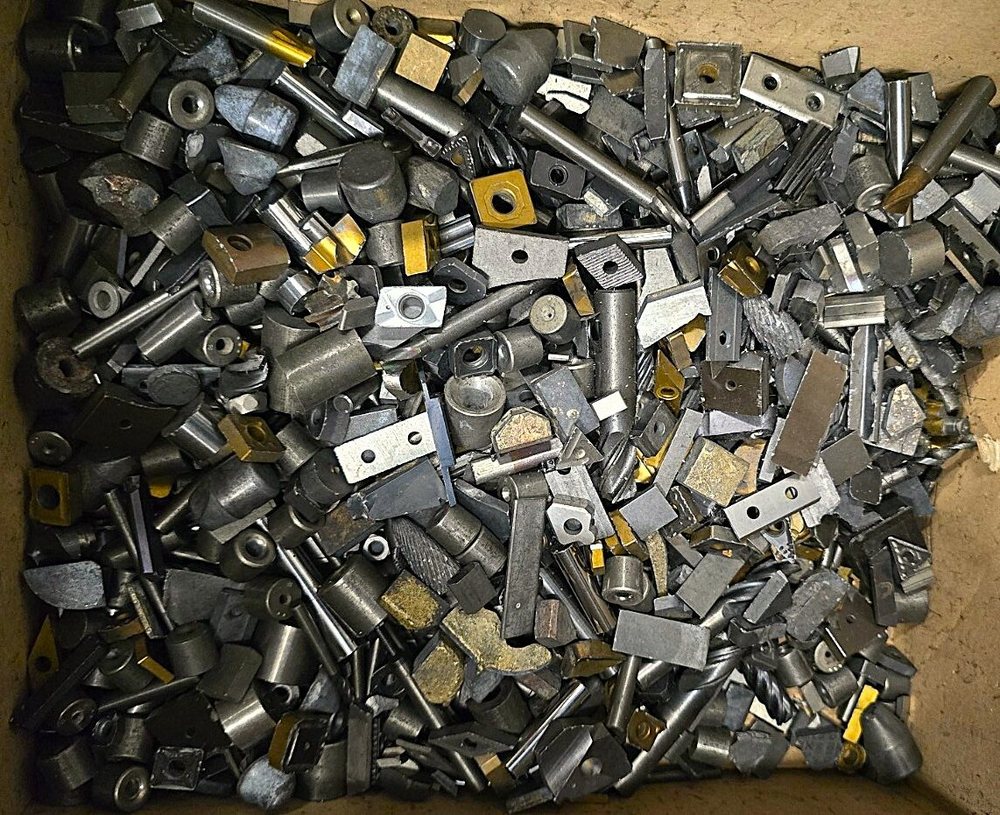
Mixed scrap arrives loose. The sorter recognises every item with an AI camera and places it in its own container.
The sorter at work: SCARA robot and an AI camera above the conveyor. Open the video on YouTube
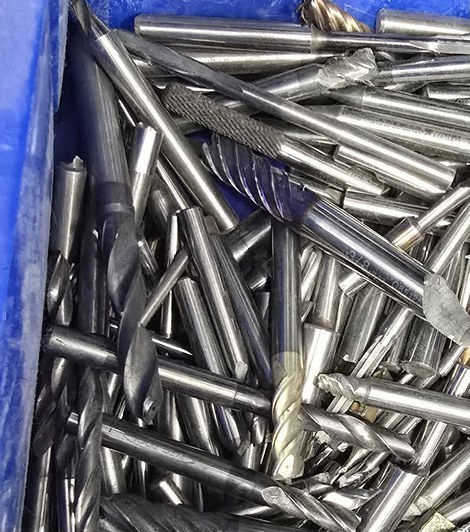
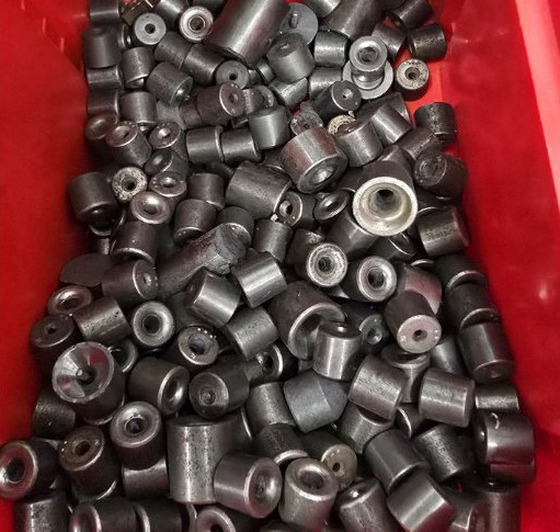
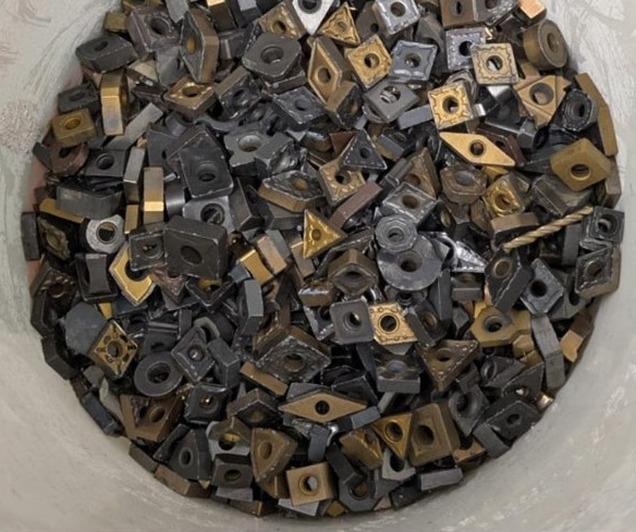
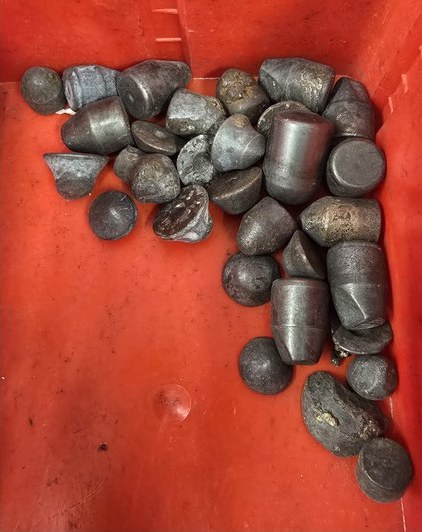
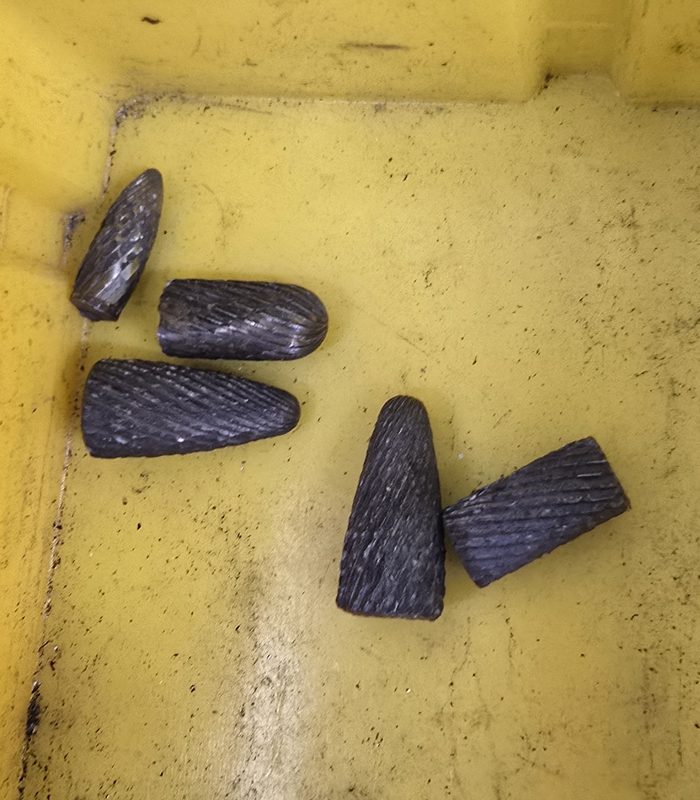
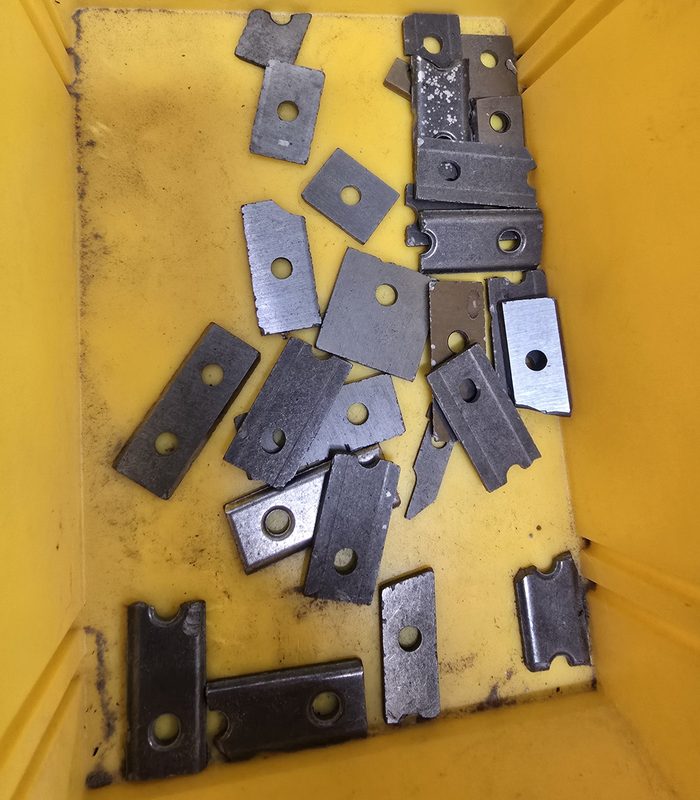
The sorter does not only sort, it also counts what passes through the machine. You just feed it material and everything else happens automatically.
For carbide tool scrap, the AI vision system recognises and classifies over 98% of items.
The sorter knows the exact number of items of each type. You get full statistics: how much of what passed through the machine and at what throughput it runs.
The robot works 24/7, which means three shifts, with no breaks, holidays, sick leave, boredom or loss of accuracy. With two people per shift, one machine replaces six people, and with one person per shift, three. You only load the material and collect the sorted fractions.
The measured power draw of the whole sorter in operation is under 300 W. A full day of 24/7 operation uses less than 7.2 kWh, which for 20 g items is under 6.3 kWh per tonne of sorted material.
Three steps, repeated in every cycle.
An AI vision system recognises every item in the sorting zone. For each item it gives the class (e.g. drills/mills, inserts, dies) and its confidence score.
An AI algorithm classifies the item and chooses the bin it belongs in.
A SCARA robot picks the item and places it in the right bin.
One robot cycle takes under 2 s. That is the time in which the SCARA robot efficiently moves the sorted items. Depending on their type and the gripper used, the times can be shorter or slightly longer.
The heavier the sorted parts, the higher the sorter's throughput. The smaller the parts, the more labour and time it takes people to sort them, which is why robotic sorting pays off so clearly.
The sorter runs continuously: 24 hours a day, 7 days a week.
Robotic sorters sort materials that people have had to sort by hand until now. AI-guided robotic sorting also recovers material that people often miss.
Milling cutters, drills, turning inserts, wire drawing dies and other cutting tools.
Details →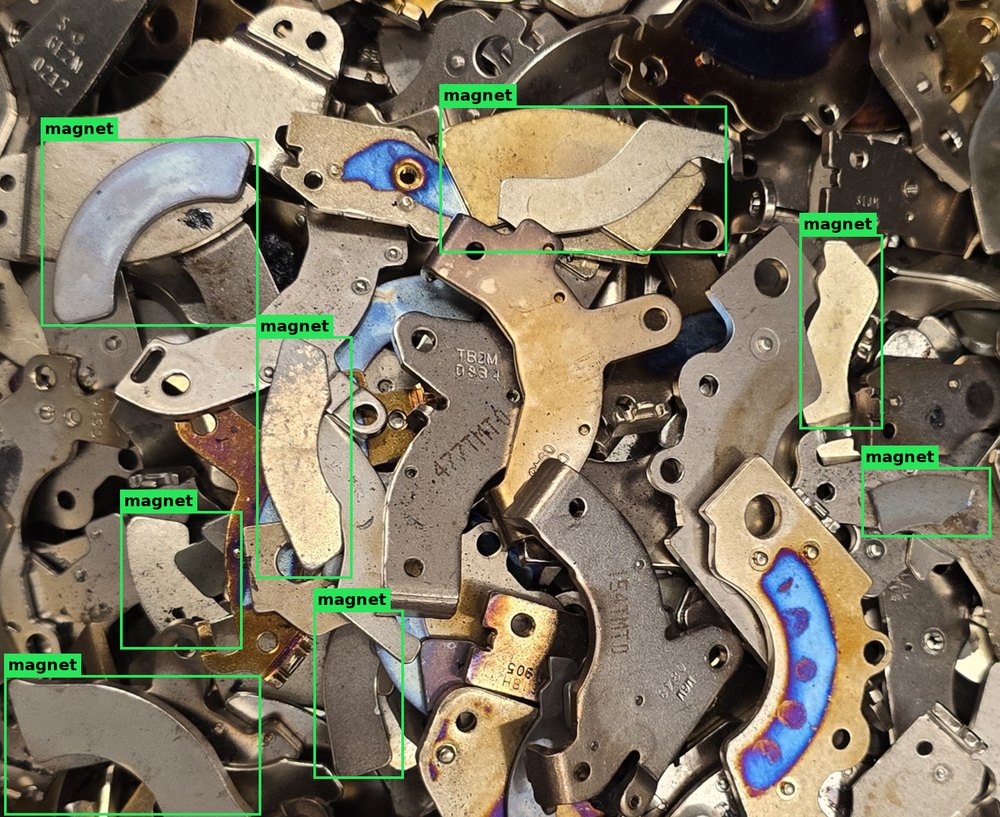
The system picks magnets out from similar-looking metal sheets.
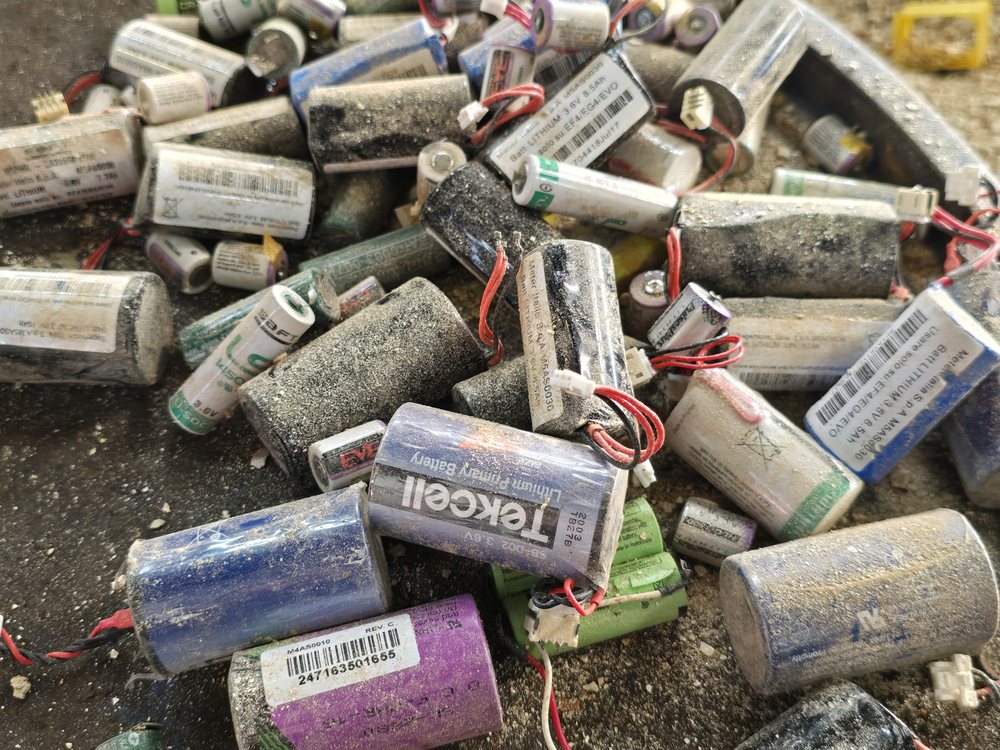
Battery sorting. We configure the sorter for the specific material.
Cleaning-up (post-sorting) of plastics.
We sort printed circuit boards by quality and separate them from other materials.
Detecting defects and rejecting unwanted items.
Another material? We build solutions from the ground up for the specific material. Tell us what you sort →

Our sorter technology was developed in the RESQTOOL project (Horizon Europe), dedicated to recovering critical raw materials from hard-metal tools (hard metals scrap). Today we also use it to sort the other materials shown above.

The RESQTOOL project (No 101138144) is funded by the European Union under Horizon Europe. Project duration: 01.12.2023 – 30.11.2027.
Range of sizes
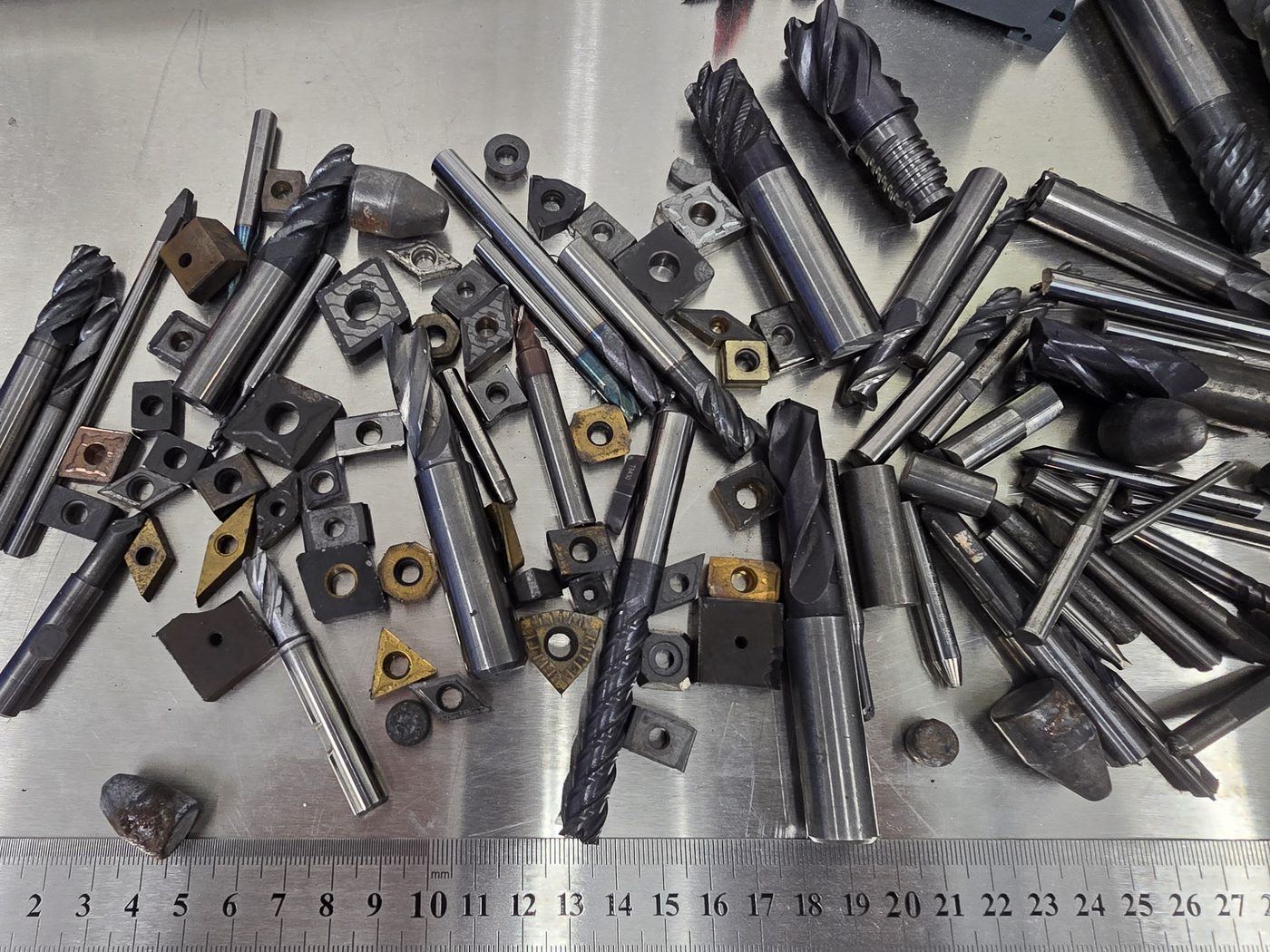
Machining-tool scrap varies widely. The photo shows an example range, from an insert weighing 0.95 g to one weighing 85 g. This is only an example: we can sort larger items too.

A sample batch of scrap: inserts, end mills and drills, mixed and lying loose.
We fit the sorter to your installation and material. Example configurations:
We place the sorter after a screen, a separator or a manual sorting station.
From material already pre-selected, e.g. on a screen, it removes unwanted items.
From a general mix it picks the specified material and places it in a separate container.
Robots can work in parallel on one stream or each on a separate material. Versions with one, two, three and four robots (PS-1 to PS-4) are available in our offer.
We sort your company's material at our site. Describe the material and quantity in the form.
The number in the model name is the number of robots. PS-1 is the single-robot version.
| Model | Phoenix Sorter PS-1 |
|---|---|
| Robot | SCARA, single robot |
| Cycle time | under 2 s |
| Throughput per hour | up to 2,400 items per hour, which at an item mass of: e.g. 20 g: about 48 kg/h e.g. 40 g: about 96 kg/h e.g. 80 g: about 192 kg/h |
| Throughput per day | up to 57,600 items per day, which at an item mass of: e.g. 20 g: about 1.15 t/day e.g. 40 g: about 2.3 t/day e.g. 80 g: about 4.6 t/day |
| Recognition | AI vision system |
| Recognition accuracy | over 98% (carbide tool scrap) |
| Power draw in operation | under 300 W (measured during operation) |
| Power supply | single-phase, 230 V AC |
| Compressed air | 8 bar |
| Dimensions (W × L × H) | approx. 1 m × 3 m × 1.7 m |
| Configurations | 1, 2, 3 or 4 robots, working in parallel or each on a separate material |
| Configuration | built from the ground up for the specific material |
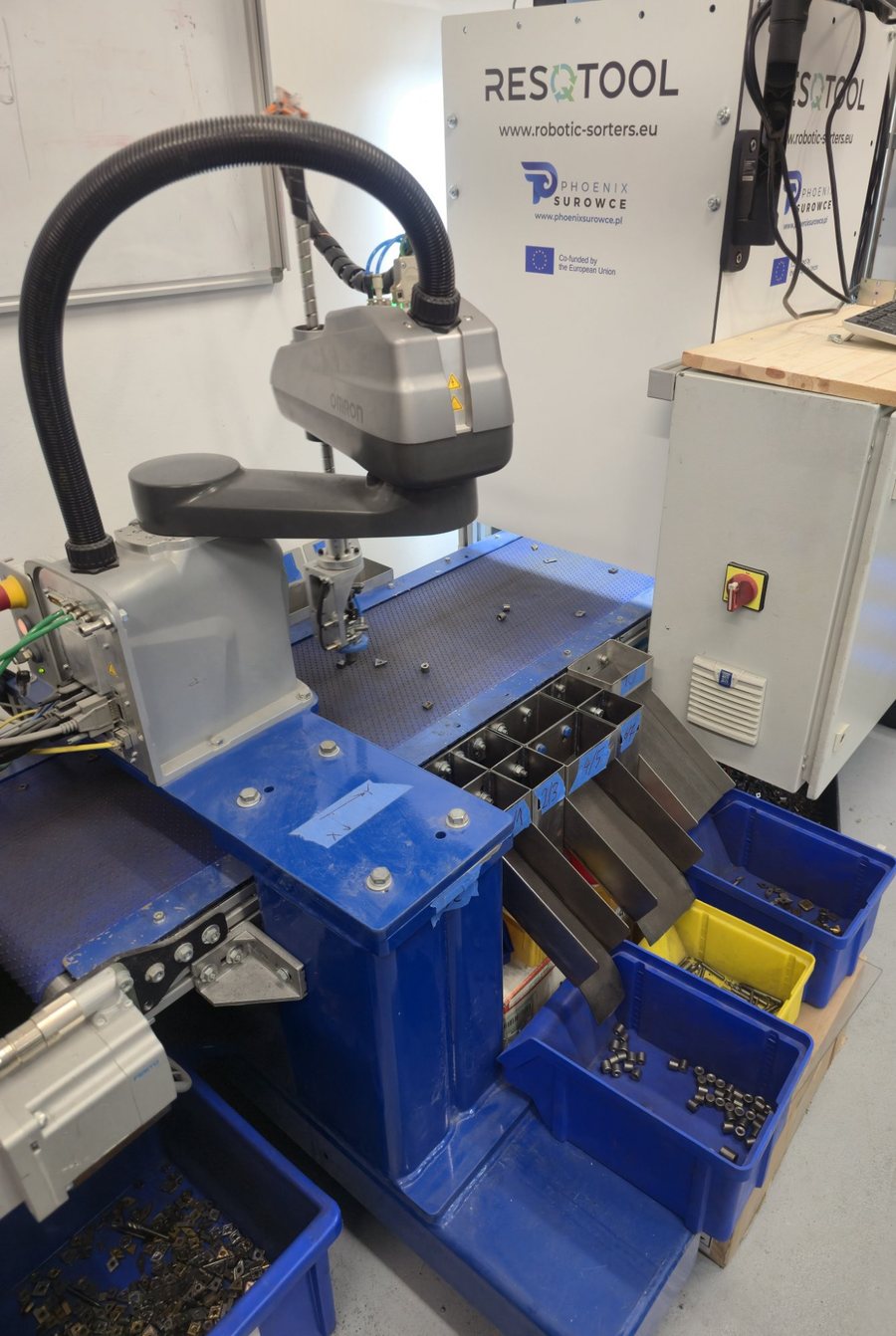
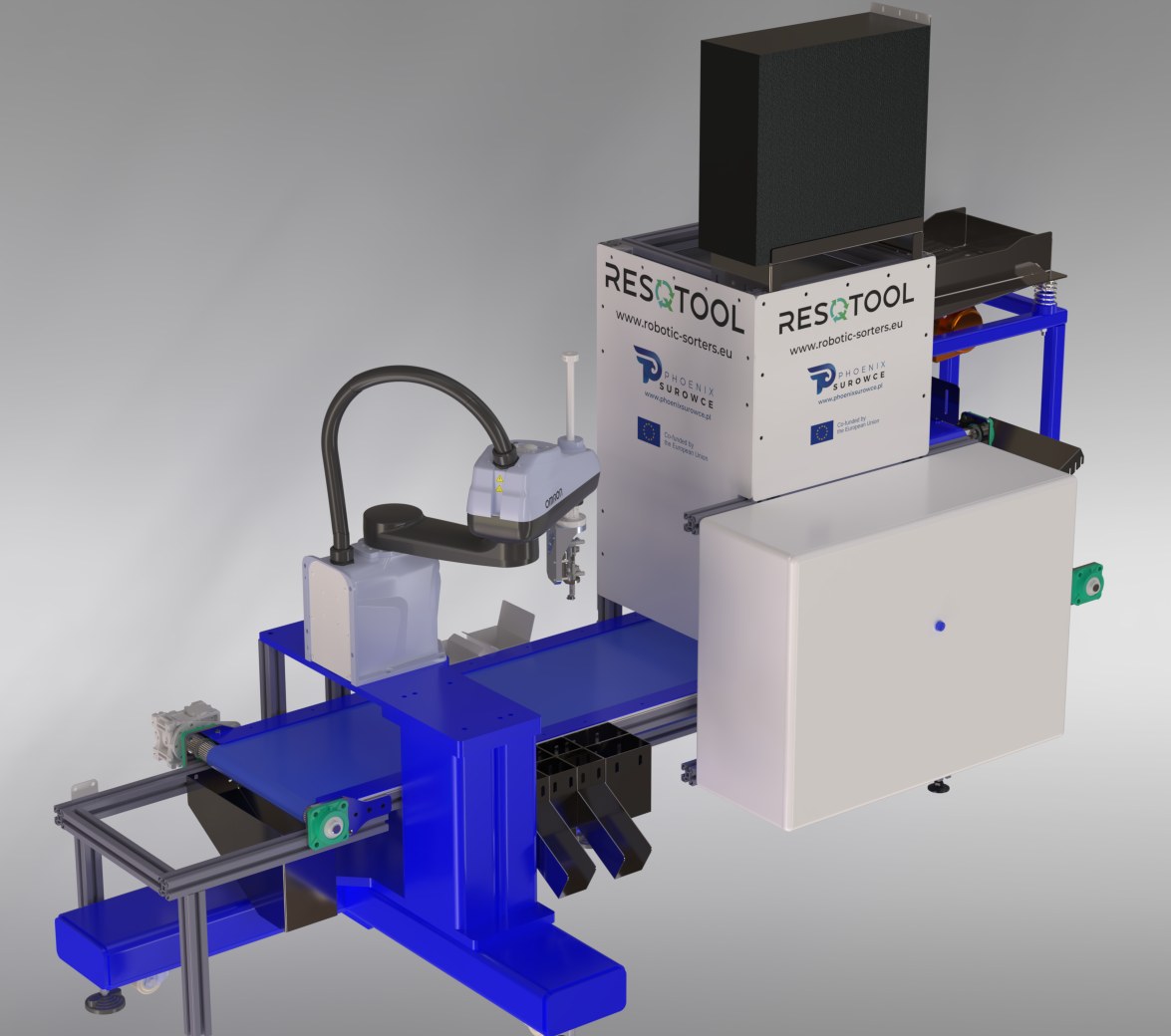
Hard metals scrap (milling cutters, drills, turning inserts, wire drawing dies), neodymium magnets picked out from similar sheets, batteries and plastics. We tailor each solution to the specific material.
One robot cycle takes under 2 s. The mass sorted per unit of time depends on the parts: the heavier they are, the higher it is, and the lighter and smaller they are, the lower.
Yes. Our solutions are developed from the ground up and tailored to the specific material. Describe your material in the contact form.
A Horizon Europe project (No 101138144) on recovering critical raw materials (including cobalt, tungsten, tantalum, titanium and niobium) from hard metal tools. The sorter technology was developed in this project.
The number in the model name is the number of robots in the sorter. PS-1 is the single-robot version.
Yes. The sorter can work after a screen, a separator or a manual sorting station, clean pre-selected material or pick a specified material from a mix. It can have 1, 2, 3 or 4 robots, working in parallel or each on a separate material.
Yes. We offer sorting of customers' materials as a service. Describe the material and quantity in the contact form.
For carbide tool scrap, recognition accuracy is over 98%.
The measured power draw of the whole PS-1 sorter in operation is under 300 W. A full day of 24/7 operation uses less than 7.2 kWh.
About 1 m wide, 3 m long and 1.7 m high.
Describe what you sort and we will calculate your benefits. We can also sort your material as a service.


